When you're trying to form an evidence-based opinion or decision, an elusive bit is: what do you believe when there's no evidence, one way or the other?
For instance, do you need evidence support for the following statements?
1. Your spouse being faithful to you.
2. The food that you're about to is not poisoned.
3. Chemtrails do not have harmful effects.
4. The man on trial is innocent.
5. The new drug doesn't have negative side effects.
6. Parachutes are useful and good for health if you're jumping from a plane.
7. COVID-19 is due to a lab-leak.
1, 2, 3, 4 are easy: the null hypothesis is that these statements are correct. 5 is also easy: the null hypothesis is that it's *incorrect*, the FDA approval requires a positive proof. This is what lawyers call a "presumption".
6 is interesting. Based on the same "gold standard" as 5, [this paper](https://www.bmj.com/content/327/7429/1459?ijkey=c3677213eca83ff6599127794fc58c4e0f6de55a&keytype2=tf_ipsecsha) shows that there's no evidence for it!
What about 7? Well, that's exactly it: it's hard to say. The reality is that you should have a Bayesian prior, based on your intuition, history, whatever it might be. You can even argue "what's a reasonable prior", but whatever it is, yelling "there's no evidence!" is stupid.
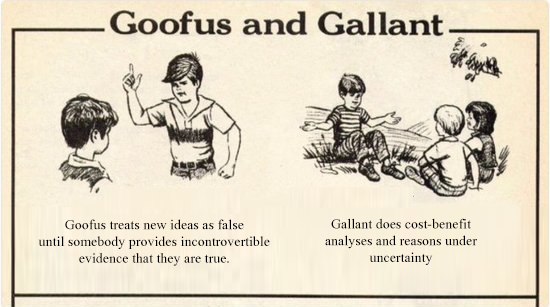
[[The sovereign is he who sets the null hypothesis]]
#published